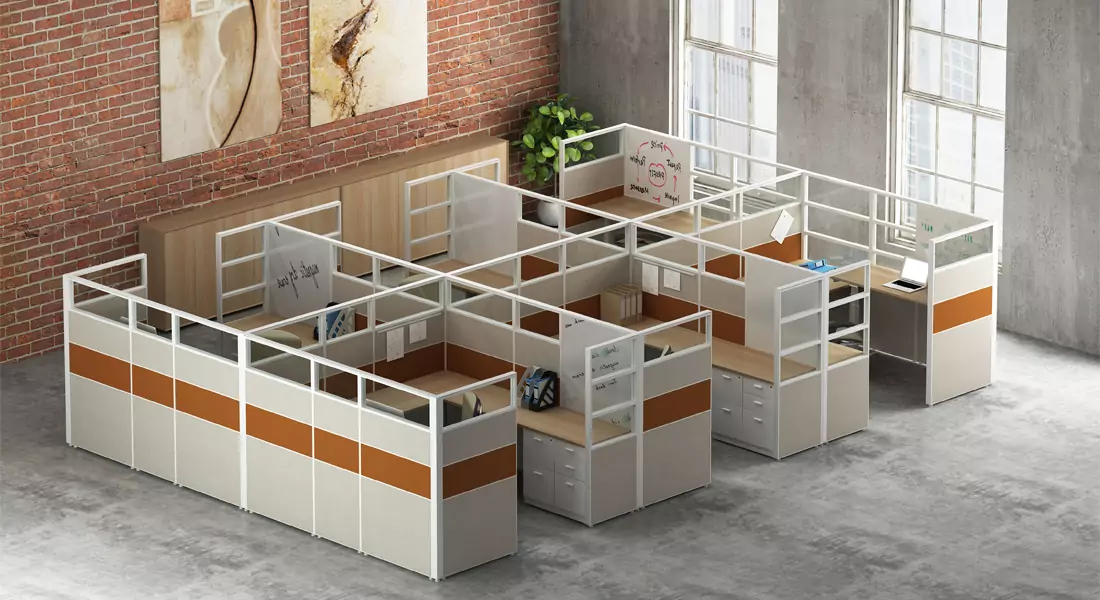
Over the past two decades, open-plan layouts gained popularity as companies sought spontaneous collaboration and an image of transparency. In practice, however, many organizations still rely on partitioned workstations to define individual work areas, manage distractions, and support different operational needs. This persistence raises a central question: do offices still use cubicles in modern workplaces?
In our observations across various commercial industries, the answer is yes, though the form and function of these workstations have evolved significantly. Rather than relying on outdated monolithic walls, modern organizations utilize modular system furniture that balances open communication with personal focus space.
We see companies across technology, financial services, customer support, logistics, and administrative sectors continuing to use partitioned workstations to make more effective use of available office space while providing defined areas for individual tasks.
The Need for Acoustic Privacy and Focused Workspaces
Research on workplace acoustics has highlighted noise and speech distractions as factors that can affect employees’ experience of open-plan office environments. Open office environments may expose personnel to conversations, ringing phones, and visual movement, which some employees may find distracting during tasks requiring sustained attention.
By integrating partitions with suitable materials and practical office furniture accessories, organizations can create more clearly defined work areas and help manage visual distractions.These features can be particularly useful in phone-heavy departments such as customer service and sales teams.
For customer service and data-intensive industries, the question of whether offices still use cubicles often arises because these workplaces often involve sustained concentration and frequent voice-based communication. Depending on the product design, modern partition walls may use different panel materials and surface finishes to help organize workspaces and address specific acoustic requirements.
In our project evaluations, we consider how defined workstation boundaries can help organize individual work areas and provide employees with a more structured environment for focused tasks.
Flexibility and Real Estate Optimization in Contemporary Offices
From a facility planning perspective, commercial real estate can represent a significant ongoing cost for many enterprises. Maximizing floor plan efficiency while considering employee comfort requires careful spatial management.
Partitioned workstation clusters allow organizations to arrange individual work areas within available floor space while maintaining a structured office layout. Unlike fixed brick or drywall partitions, modular cubicles can offer greater flexibility, allowing facility teams to adjust workstation layouts as team sizes and workspace requirements change.
Modular workstation systems complemented by practical office furniture accessories can help facility planners adjust desk configurations while reducing the need for major layout changes. Furthermore, integrated cable management channels built into some partition frames can help keep power cables, network wiring, and data cords organized and accessible.
In our review of modern floor plans, compact multi-person workstation clusters can provide an alternative to standalone desks, depending on available space and team requirements. This approach can help growing businesses plan workstation capacity within existing office space while considering employee needs, available floor area, and operational budgets.
Tailored Solutions from Leading Commercial Office Furniture Manufacturers
At XINDA CLOVER, we offer call center cubicles and partition workstations designed for a range of modern commercial environments.As a commercial office furniture provider, we offer modular call center cubicles and partition workstations for different office layouts.
Our product lines include partition systems with different frame materials, panel options, and connection methods to accommodate a range of workstation configurations.
In addition to call center cubicles for multi-person workspaces, we offer a range of workstation accessories, which may include fabric desk dividers, desktop whiteboards, paper trays, pencil holders, and mobile storage cabinets, depending on product availability.
With customization options for colors and material finishes, we help businesses select workstation solutions that suit their office layouts, design preferences, and operational requirements.
Balancing Collaboration and Autonomy for Long-Term Workplace Efficiency
As workplace strategies evolve, office design does not have to be a choice between total openness and total isolation. Effective facility planning can combine collaborative zones with defined areas for focused individual work.
Modern cubicle systems have evolved into adaptable workspace components that can be configured for different departmental needs. Call centers may use higher partitions to define individual work areas, while creative teams may prefer lower screens that maintain visibility and support communication.
By considering partition heights, panel materials, and workstation layouts, business leaders can select configurations that accommodate different work activities and spatial requirements.
We consider partitioned workstations a practical option for many corporate offices because they offer a way to organize individual work areas while allowing layouts to be adjusted as needs change. As commercial spaces adapt to changing working patterns, adaptable workstation systems are likely to remain relevant in many business environments.