Choosing an OEM (Original Equipment Manufacturer) or ODM (Original Design Manufacturer) office furniture partner in China affects purchasing cost and project timelines. It also determines who owns the design. This article covers the key factors for evaluating both the cooperation model and the factory.
Key Takeaways
OEM = The buyer designs, and the factory manufactures.
ODM = The factory designs, or adjusts an existing factory design, and the buyer customizes and brands it.
1. Core points for choosing a custom office furniture partner in China:
2. Choose an OEM or ODM model based on project needs.
3. Explore China’s established furniture manufacturing clusters.
4. Verify the supplier’s registration details, factory identity, and actual production capacity.
5. Before sharing sensitive drawings, clarify design ownership and assess and file applicable IP applications. Also sign an NNN (Non-Disclosure, Non-Use, and Non-Circumvention Agreement) suited to manufacturing cooperation in China.
6. Negotiate MOQ, price, and lead time, and calculate total landed cost.
7. Agree on quality standards and an inspection plan in advance, and complete batch checks before shipment.
(These steps can be adjusted or run in parallel depending on the project. Wish you find a suitable and reliable partner.)
Choose OEM or ODM Model for Custom Office Furniture
OEM means the buyer supplies CAD drawings, material specifications, and technical files, while the factory manufactures to those requirements. Design ownership is usually retained by the buyer, subject to the contract. This route gives greater control and exclusivity, but tooling, testing, and sampling increase cost and development time.
ODM starts with a factory-developed model. The buyer may change dimensions, finishes, fabrics, packaging, or branding. It generally reduces development work and supports market testing, although the underlying design normally remains the factory’s IP unless exclusivity is separately negotiated.
Item | OEM | ODM |
Product design | Provided by the customer | Provided by the factory |
Development method | Produced to customer drawings or specifications | Produced or modified from the factory’s existing designs |
Tooling/R&D | Usually led by the customer | Usually led by the factory |
Intellectual property | Usually the customer’s, or as agreed in the contract | Usually the factory’s, or as agreed in the contract |
Degree of customization | ⭐⭐⭐⭐⭐ High | ⭐⭐⭐ Medium to high |
Development time | Usually longer | Usually shorter |
Development cost | Usually higher | Usually lower |
Suited to | Customers with their own product designs and brand | Customers with a brand but no R&D or design capability |
Example
OEM:
A customer gives an office furniture factory a complete 3D drawing of an office desk: “Produce 5,000 desks to my design. Color, material, and size must all follow my requirements.”
The factory handles procurement, production, quality inspection, and packing. This is OEM.
ODM:
A factory has already developed an office desk. The customer likes it, then switches to a specified material, changes the color, adds the customer’s logo, and sells it under the customer’s brand. This is a typical ODM case.
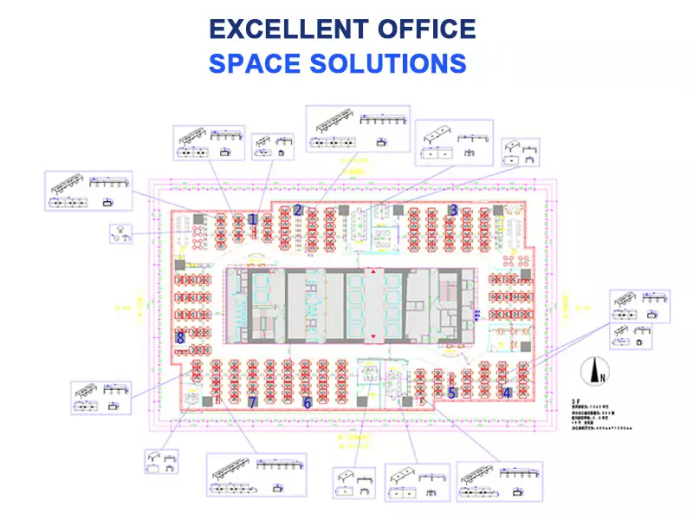
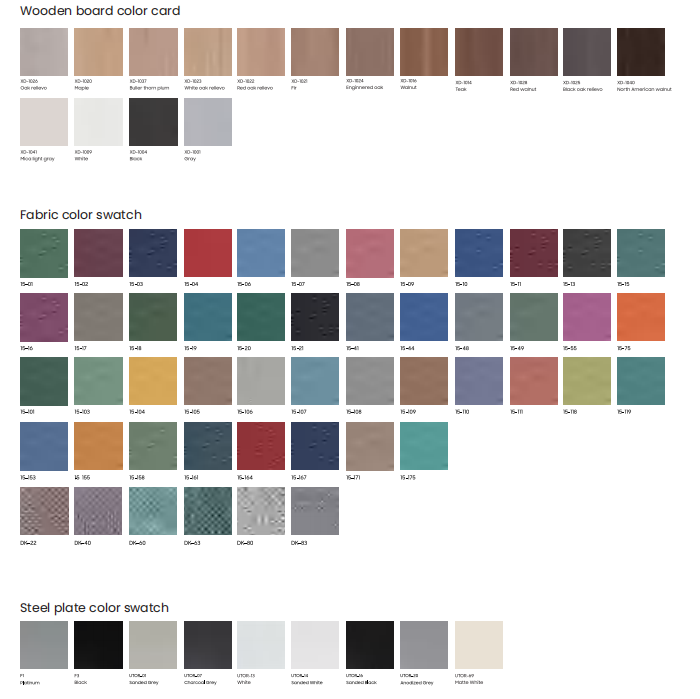
CAD Drawing Example: Color Customization Options Example:
Match China’s Furniture Manufacturing Cluster
China’s furniture clusters have different strengths. Location can serve as one reference point when shortlisting suppliers.
▪ Foshan and Shunde, Guangdong: A large global hub for furniture manufacturing and exhibitions, with a very complete supporting supply chain. Well suited to combined sourcing of office furniture, apartment furniture, and project packages. Buyers can view samples in person while confirming whether the counterparty is the actual factory.
▪ Dongguan, Guangdong: Export-focused custom work, including solid wood, veneer, upholstery, and drawing-led projects.
▪ Anji, Zhejiang: Office seating and related components. Anji’s government describes it as a globally recognized office-chair cluster with a concentrated supply chain.
▪ Qingdao, Shandong, and northern clusters: Solid-wood, panel, flat-pack, metal, and glass categories vary by locality. Qingdao is expanding an integrated solid-wood furniture park.
▪ Guangzhou, Jiangsu, and Chengdu: Useful options for multi-category coordination, East China contract production, and panel-based whole-space customization, respectively.
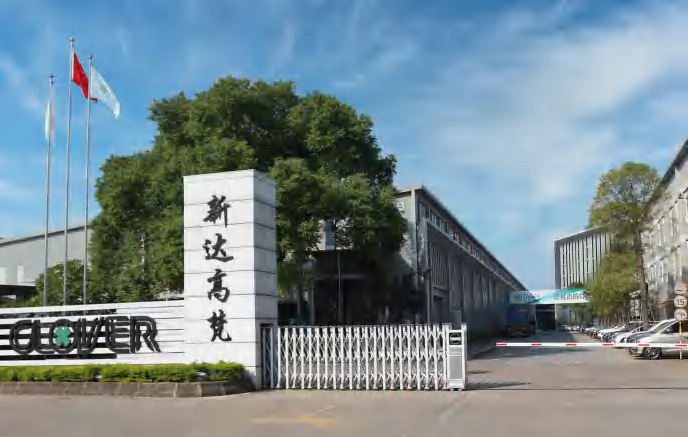
Xinda Clover is located in Nanhai, Foshan. Its factory covers 120,000 square meters and handles desks, seating, partitions, storage furniture, aluminum profiles, mold development, and related components. For buyers who want to consolidate several categories, Xinda Clover can be considered a reliable custom office furniture solutions supplier.

Exterior view of Xinda Clover, an office furniture solutions provider in Foshan, China
Verify Office Furniture Factory and Capacity
Start with the factory’s registered Chinese name, Unified Social Credit Code, address, business scope, and legal representative. China’s National Enterprise Credit Information Publicity System publishes registration details, including business scope and establishment date.
A live video audit can cover the raw-material warehouse, production lines, edge bander, assembly points, inspection area, and packing zone.
Capacity is the ability to maintain specification, consistency, and delivery at volume. Review process controls, skilled staffing, equipment loading, approved material sources, change control, contingency plans, and valid certificates such as ISO 9001. Before contracting, ask for actual monthly capacity, batch-consistency controls, engineering-change procedures, material-shortage plans, and pre-shipment acceptance rules.
Protect Design IP
Confirm who owns the IP before giving designs to a Chinese factory. China uses a first-to-file system, and public disclosure before filing can affect novelty.
▪ With OEM, the drawings are the buyer’s core asset. Before sharing drawings or displaying the product publicly, the buyer can file a design patent in the brand owner’s name. Granted rights can also be recorded with China Customs.
▪ With ODM, the underlying design usually belongs to the factory. The contract can therefore state who owns the buyer’s modifications and whether the buyer has exclusive rights.
In either model, consider signing an NNN agreement (Non-Disclosure, Non-Use, and Non-Circumvention Agreement).
Inspect Before Loading
Pre-shipment inspection compares the finished batch against the signed specification and the sealed approved sample. It usually covers six areas:
Area | Examples |
Specification | SKU, quantity, dimensions, finish |
Appearance | Color and texture consistent with the approved sample |
Materials | Fabric, mesh, foam, veneer, panel laminate |
Function | Adjustment functions, stability, noise, joints |
Components | Gas lift, base, casters, hardware |
Packing | Carton strength, labels, barcodes |
The applicable test standards depend on the destination market. Common references include:
Region | Office chairs | Desks and tables |
North America | ||
Europe | ||
International |
Buyers can confirm the required standard with their importer or end customer before ordering. A laboratory report applies only to the tested sample, so bulk-production components can be checked against it.
Third-party inspectors often use sampling plans such as ISO 2859-1, which is indexed by acceptance quality limit (AQL). The AQL level is agreed per project. Before release, the factory may be asked to provide an evidence pack. It can include the sample size, defects found, corrective actions, function-test photos or videos, and a signed release document.
Negotiate MOQ and Landed Cost
For office furniture, MOQ is usually set per model (SKU). It may also be set by specification, such as color or size, or by total order value. Buyers can first ask whether MOQ is calculated per model, per specification, or per order.
When comparing quotes, convert them to landed cost, the total cost of delivering goods to the buyer’s warehouse. Besides the unit price of finished goods, it may include tooling and samples, export packing, freight and insurance, duties and import taxes, port and customs fees, and final delivery and storage. Duties and taxes vary by HS code, origin, and destination country, so a local customs broker can confirm them before purchase.
What Xinda Clover Offers for Custom OEM and ODM Office Furniture
1. OEM process: Customer submits drawings → technical feasibility check → details discussed with the customer → sampling drawings confirmed → factory sampling → quality inspection → packing and shipment.
2. ODM process: Customer selects a factory model and requests detail changes → technical assessment and pricing → drawings issued and confirmed → sampling or mass production confirmed → quality inspection → packing and shipment.
Strengths of Xinda Clover:
• Founded in 1990. Maintains long-term relationships with leading global brands, including HNISteelcase, Global, AMQ, and Kagukuro.
• Colors, materials, and sizes can all be customized.
• No MOQ requirement. Larger quantities receive greater discounts.
• Can design office spaces, such as schools and healthcare facilities. Professional CAD drawings and renderings are available, depending on the contract.
• Three-year warranty. Damage caused by Xinda Clover’s quality issues or by handling can be replaced.
• Key data: production base of about 120,000 m²; 6,000 m² office furniture showroom; 141+ valid national patents; 100% full inspection with a defect rate below 2%; 500+ technical professionals.
• The full Xinda Clover product range holds China Environmental Labeling certification;one of the first Chinese companies to obtain GREENGUARD indoor air quality certification.
• Insists on using PEFC- (or FSC-) certified products.
(PEFC and FSC are the two major international forest certification systems. Independent third parties verify that the wood used in the products comes from responsibly managed forests.)
Final Thoughts
Foshan is a practical starting point for sourcing multiple categories of office furniture. When a project requires coordinated OEM/ODM production, CAD support, and several office furniture categories wholesale, Xinda Clover can be considered. Complete specifications, contracts, inspection plans, and landed-cost models support evidence-based supplier selection.