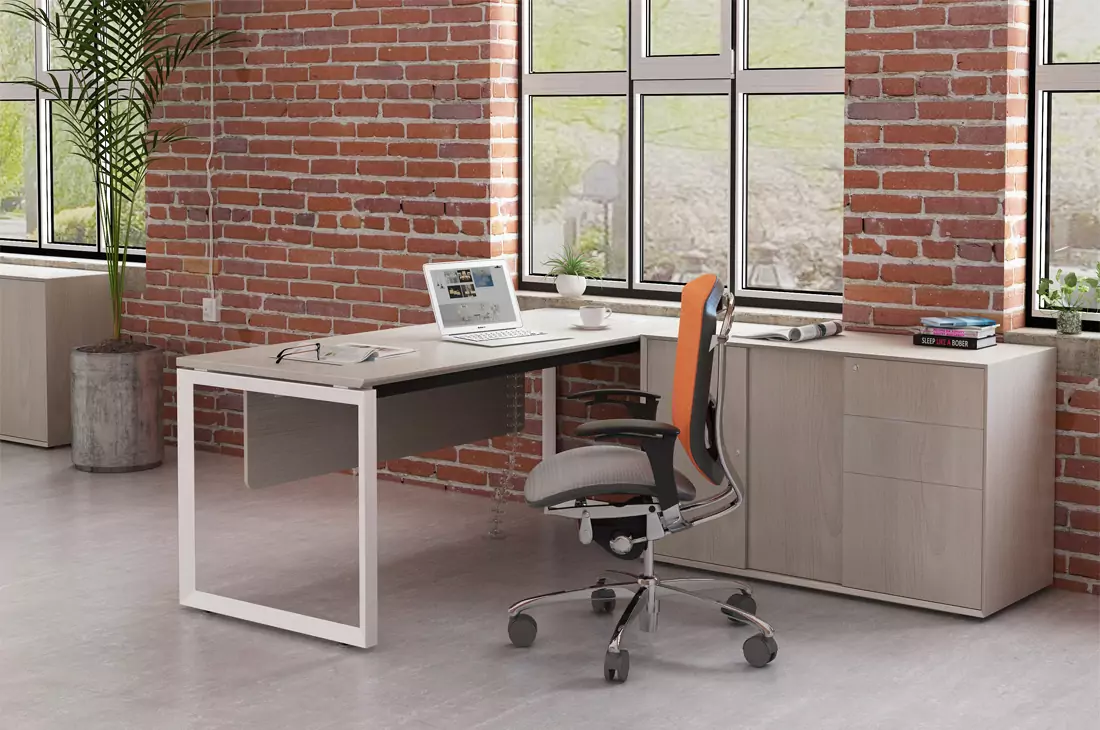
When selecting executive workstations, buyers should consider desk dimensions, storage capacity, cable access, and compatibility with meeting and computer equipment.
From a commercial furniture manufacturing perspective, executive furniture selection should consider workplace functionality, organizational image, and spatial efficiency. Modern corporate environments require a thoughtful balance between executive stature, operational functionality, and ergonomic support.
When business leaders plan new facilities or renovate existing administrative suites, furniture selection can influence daily workflows, workspace comfort, and corporate aesthetics. Executive offices, in particular, serve as both private workspaces for decision-making and formal meeting areas for executive leadership, board members, and visiting clients.
Consequently, evaluating how administrative furniture fits into office layouts requires consideration of materials, cable management, spatial proportions, and the functional needs of different work areas. As technology and work arrangements change, furniture selection requires consideration of both current workspace needs and future layout requirements.
Structural Considerations in Modern Executive Furniture Design
When evaluating premium desk construction, structural integrity and material durability are important considerations for long-term furniture use. Executive desks may use engineered wood panels, high-pressure laminate surfaces, or natural wood veneers, depending on the product design and finish requirements. Buyers should evaluate surface durability and moisture resistance according to the manufacturer’s specifications.
In our facility assessments, we consider frame construction, joint design, and leg configuration when evaluating whether executive desks are suitable for their intended equipment loads. Executive work surfaces should be selected according to equipment requirements, with options such as embedded power modules, cable channels, and integrated storage considered where available.
Proper wire management channels can help organize power and data cables, while electrical components should be selected and installed according to applicable safety requirements. By considering structural design, storage options, and product specifications, enterprise buyers can select executive desks suited to their intended use and maintenance requirements.
Integrating Ergonomics into Modern Office Workstation Systems
Beyond individual executive suites, scaling comfortable work environments across entire departments requires systematic spatial planning. Integrating customizable office workstation systems allows organizations to arrange work areas according to different job requirements while considering ergonomic needs and privacy preferences.
We observe that modular workstation systems can offer different panel heights, surface materials, and desk configurations to accommodate diverse departmental requirements, depending on the product range. For instance, administrative teams may prefer higher partitions to define individual work areas, whereas project teams may choose lower partitions to maintain visibility and facilitate communication.
Incorporating modern office workstation systems into open floor plans can help define individual work areas and manage visual distractions, depending on the layout and partition configuration. Where compatible with the workstation design, height-adjustable desks allow employees to alternate between sitting and standing throughout the workday, supporting greater flexibility in workstation use.
Material Standards and Environmental Factors in Commercial Manufacturing
From a commercial procurement standpoint, reviewing applicable manufacturing standards, product test reports, and environmental certifications can help enterprise buyers assess furniture specifications and procurement requirements. Commercial furniture quality control may include checks for formaldehyde emissions, surface durability, and structural load capacity, depending on the product specifications and applicable testing requirements.
In our consultations with international buyers, we emphasize that sourcing from an office desk manufacturer in China can provide access to a range of product options and manufacturing capabilities, depending on the supplier’s facilities and production capacity. Furniture manufacturers may use different woodworking, edge-banding, and surface-finishing processes to meet product specifications and production requirements.
Working with an office desk manufacturer in China can help corporate buyers evaluate executive desks and modular workstation components according to their project requirements.
Manufacturin Excellence from XINDA CLOVER
At XINDA CLOVER, we offer commercial furniture solutions designed for a range of modern office environments. As a commercial furniture manufacturer, we offer product options including executive desks, office seating, modular partitions, and private cubicles, subject to our current product range.
Our administrative furniture options include different panel materials, frame configurations, and modular accessories to accommodate various cable management and workspace layout requirements. Our product development and quality control processes take into account product specifications, intended applications, and applicable quality requirements.
By offering customization options in material finishes, colors, and dimensions where available, we help corporate buyers, facility managers, and distributors select furniture solutions suited to their project requirements.
Optimizing Spatial Distribution for Long-Term Workspace Flexibility
Ultimately, designing a functional commercial office layout requires aligning furniture choices with business requirements and employee needs. Selecting suitable executive desks and adaptable modular systems can help organizations create workspaces that accommodate different tasks and operational activities.
We encourage facility planners to evaluate floor plans holistically, considering workspace requirements, traffic flow, natural lighting, and potential future expansion. Modular systems with compatible connection components can make it easier to adjust layouts as department sizes and operational needs change, depending on the existing furniture configuration.
By combining executive design with practical workspace planning, businesses can select office furniture that reflects their corporate identity while accommodating daily work activities and future layout requirements.